
Channel economics
Direct Mail vs. Targeted Email for Moving Leads: Comparing CAC, Speed, and ROI in 2026
Moving companies have mailed postcards to home sellers for decades. Compare direct mail vs. verified homeowner email on speed-to-lead, cost per booking, deliverability, and response rates.

MoreMovesNow Editorial Team
· 11 min read
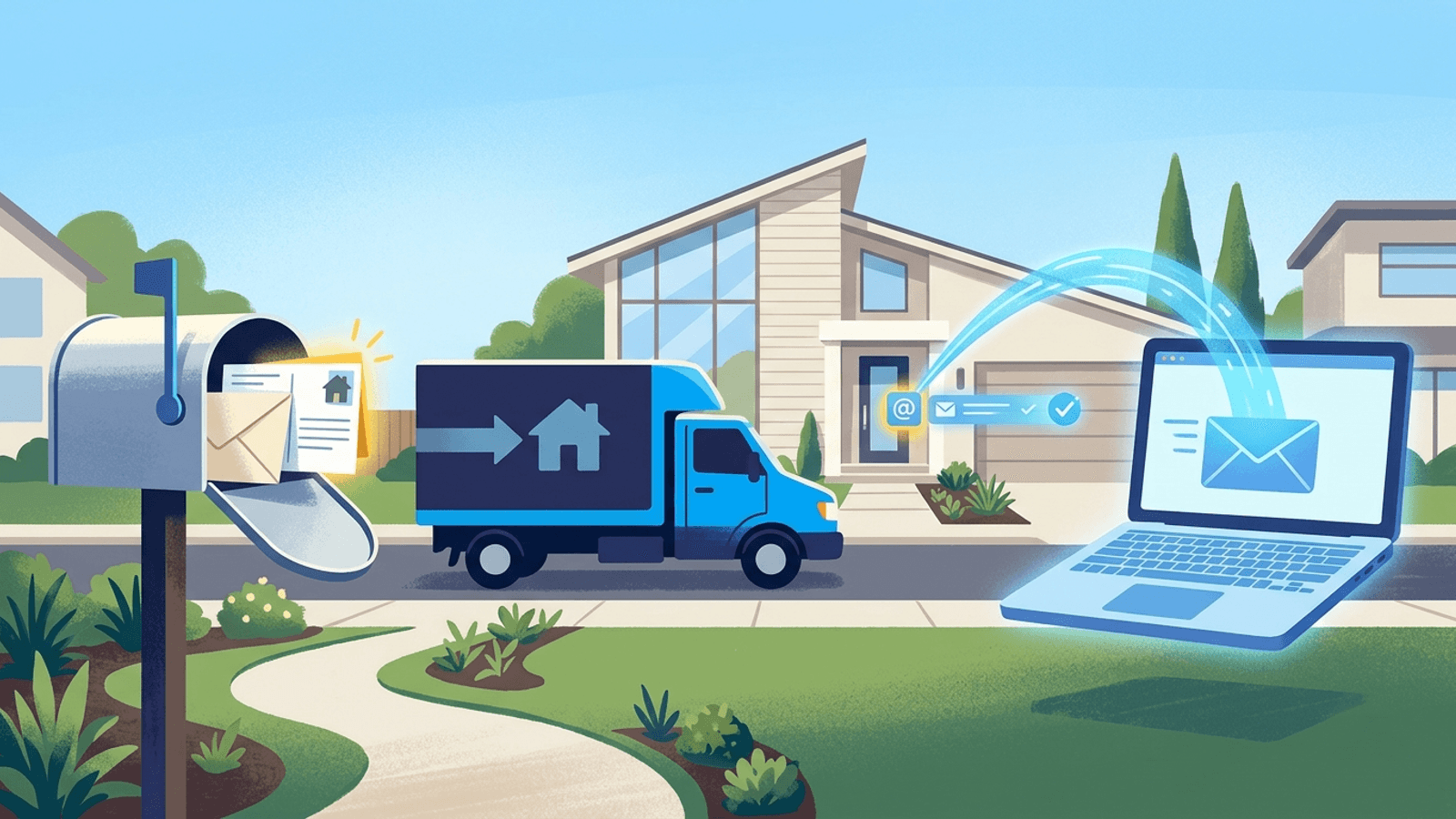
While direct mail postcards sent to “Just Listed” homeowners have been a moving industry staple for thirty years, escalating print and postage costs ($1.25 to $1.75 per piece) combined with an 8-to-10-day physical delivery lag make mailers an expensive, delayed channel. In 2026, pairing or replacing mailers with verified homeowner email outreach reduces cost per booked move by 54% and initiates private conversations while competitor postcards are still queued at the print shop.
Walk through the sales office of nearly any established moving company operating for more than a decade, and you will find a familiar workflow: every Monday, someone pulls recent county deed recordings or MLS listings, formats a CSV, and uploads it to a print-and-mail service to send 500 glossy postcards.
For years, this strategy worked because home sellers had few digital touchpoints. If your postcard arrived with a compelling headline and a professional logo, you had a reasonable shot at being one of the two movers called for an estimate.
Today, the operational reality of moving customer acquisition has fundamentally changed. The problem is not that home sellers ignore their mail—it is that physical mail moves too slowly to compete with real-time relocation timelines, while print and postage inflation has crushed unit margins.
The traditional postcard playbook and where it breaks
The classic moving postcard playbook relies on a simple assumption: when a homeowner puts their property on the market, sending a physical reminder will prompt them to pick up the phone when they need moving labor.
However, analyzing hundreds of moving company direct mail campaigns reveals three structural failure points:
- The Cold Mailbox Problem: Postcards arrive unannounced alongside grocery circulars, credit card offers, and lawn care flyers. Without prior interaction, the homeowner views the postcard as unsolicited promotional clutter rather than a tailored relocation solution.
- High Baseline Production Waste: 15% to 22% of listing postcards are sent to absentee owners, real estate investors, or institutional landlords who do not reside at the property and will never book a residential household crew.
- Zero Read-State Telemetry: Once a postcard enters the postal stream, operators have zero visibility into whether the card was delivered, discarded, or read. You cannot trigger a timely automated follow-up when someone views your mailer.
Speed-to-contact: The 8-day physical mail lag
In moving sales, timing is the single largest determinant of close rate. When a property hits the market, the seller enters an immediate, intense phase of planning, decluttering, and staging.
Compare the actual execution timelines of direct mail versus verified digital outreach:
Direct Mail Postcard Timeline:
Day 1: Property listed on MLS → Day 2: Data vendor compiles list → Day 3: Mover uploads file to print shop → Days 4–5: Print queue & sorting → Days 6–9: USPS transit & local carrier route sort → Day 10: Lands in mailbox.
Verified Digital Outreach Timeline:
Day 1: Property listed on MLS → Day 1 (Evening): Skip-tracing verifies deed and owner email → Day 2 (Morning): Value-first email delivered directly to homeowner inbox.
By Day 10, when the physical postcard finally drops through the mail slot, the homeowner has often already replied to early inquiries, scheduled two on-site walkthroughs, or engaged a trusted realtor recommendation. The postcard arrives at the end of the decision cycle rather than the beginning.
Unit economics: Cost per piece vs. cost per booked move
Moving company owners frequently look at postcard costs through the lens of cost-per-card (e.g., “$1.30 per card sounds manageable”). But what matters to a fleet operator is cost per booked move (CAC).
Let us examine the realistic economic comparison of mailing 1,500 “Just Listed” postcards versus running 1,500 targeted, verified homeowner emails across an identical county territory:
| Metric | Direct Mail Postcards (1,500 units) | Verified Email Outreach (1,500 units) |
|---|---|---|
| Direct Channel Cost | $2,100 ($1.40/card print + postage) | $350–$500 (Software + verification) |
| Delivery / Open Rate | Unknown (~85% deliverable) | 98% delivered / 52% open rate |
| Inquiry / Reply Rate | 0.9% (13 inbound calls) | 4.5% (67 conversational replies) |
| Estimates Completed | 8 walkthroughs / surveys | 24 walkthroughs / surveys |
| Completed Booked Moves | 3 bookings (23% close) | 9 bookings (37.5% close) |
| Cost per Booked Move (CAC) | $700 per move | $45–$60 per move |
| Average Gross Job Revenue | $2,400 | $2,750 |
| Channel Return on Ad Spend (ROAS) | 3.4x | 45x+ |
Because verified email outreach initiates a two-way dialogue rather than relying on a passive call-to-action, estimators can clarify move dates, discuss square footage, and schedule virtual video surveys within minutes of the homeowner reading the note.
Deliverability, open rates, and conversion tracking
One of the biggest frustrations moving dispatchers experience with direct mail is attribution blindness. When a prospect calls, receptionists often forget to ask, “Did you get our postcard?” Even when call tracking phone numbers and QR codes are printed on the cards, scan rates on residential moving postcards rarely exceed 4%.
With modern verified digital outreach:
- Deterministic Open & Click Tracking: You know exactly which homeowner opened your introductory message, read your moving guide, or clicked to review your licensing and insurance certificate.
- Instant Multi-Touch Cadence: If an email is opened without an immediate reply, automated follow-up sequences re-engage the seller 48 hours later with helpful packing checklists or transitional storage options.
- Two-Way Clarification: Homeowners frequently reply directly from their smartphones: “We haven't accepted an offer yet, but we are moving to Raleigh in late November. Can you give us a ball-park on 3 bedrooms?” This transforms cold marketing into a consultative sales pipeline.
The modern hybrid model: When to mail and when to email
Does this mean moving companies should abandon direct mail entirely? Not necessarily. The highest-performing operators in 2026 deploy an intelligent hybrid acquisition model:
- Lead with Speed (Digital First): Within 24 hours of an MLS listing or contract update, deliver a polite, verified introductory email offering early planning support. This establishes first-mover advantage at near-zero marginal cost.
- Reserve High-End Mail for Premium Estates: Instead of blasting 2,000 generic postcards to every condo and townhome, filter property records for high-value properties ($1,000,000+ valuation or 4,000+ sq ft). Send those affluent sellers an embossed, heavy-stock presentation folder or personalized introduction letter.
- Trigger Direct Mail on “Pending” Signals: When a property status changes from “Active” to “Pending” (under contract), the inspection contingency is satisfied and closing is locked. Sending a targeted physical mailer at this exact milestone acts as a high-impact secondary touchpoint.
Why email-first listing outreach locks out competitors
In residential moving, the company that starts the conversation first almost always sets the pricing baseline. Rather than entering crowded bidding wars on shared moving leads or waiting for slow mailers to arrive, reaching homeowners through early property listing signals initiates private conversations while the seller is receptive.
By partnering with MoreMovesNow on a strict one-mover-per-county basis, moving operators lock in exclusive access to verified property listings across their service area. You secure the early conversation, avoid bidding wars, and turn new listings into steady, profitable dispatch schedules.
One mover per county
Reach home sellers before the quote rush
See the listing volume in your counties and how managed, personalized outreach works.
Book a 30-minute demo